GSTR-1 Reconciliation Tool
GSTR-1 Books vs E-Invoice Reconciliation Tool
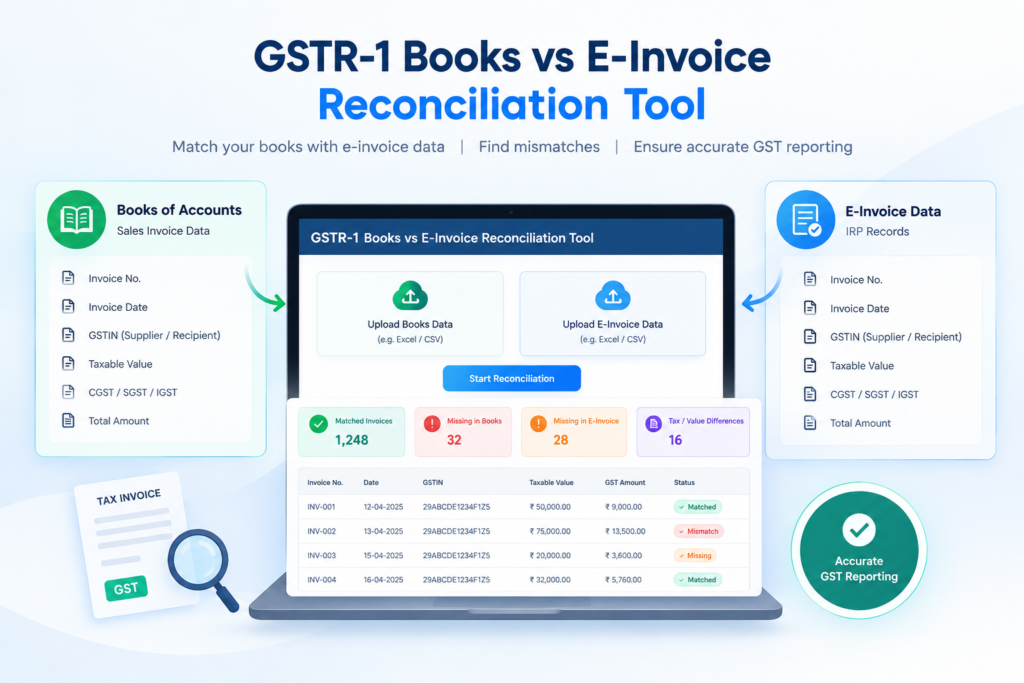
GSTR-1 Books vs E-Invoice Reconciliation Tool helps businesses, accountants, chartered accountants, and GST practitioners reconcile sales invoice data from their books of accounts with e-invoice records. This tool helps identify missing invoices, duplicate entries, taxable value differences, and GST amount mismatches, making the reconciliation process faster and more organized.
Managing GST compliance requires accurate invoice records and proper reporting. Businesses need to ensure that sales transactions recorded in their accounting software are consistent with the relevant e-invoice data. Manual verification can be time-consuming, particularly for businesses handling a large volume of invoices every month.
Our GSTR-1 Books vs E-Invoice Reconciliation Tool is designed to simplify invoice comparison and help users identify discrepancies before completing their GST return preparation.
What Is a GSTR-1 Books vs E-Invoice Reconciliation Tool?
A GSTR-1 Books vs E-Invoice Reconciliation Tool compares sales invoice data maintained in accounting books with the corresponding e-invoice records. It helps users identify matching invoices, missing records, and differences in important invoice details.
Businesses may maintain their sales records in accounting software, ERP systems, or Excel spreadsheets. E-invoice records, meanwhile, are generated through the applicable Invoice Registration Portal (IRP). Comparing both datasets helps finance teams review the consistency of their records.
Using a GSTR-1 Books vs E-Invoice Reconciliation Tool can reduce repetitive manual work and provide a structured way to investigate differences in invoice numbers, GSTINs, taxable values, and tax amounts.
Key Features of Our GST Reconciliation Tool
1. Books vs E-Invoice Data Matching
Compare accounting records with e-invoice data using supported fields such as invoice number, invoice date, supplier GSTIN, recipient GSTIN, taxable value, and GST amounts. The matching results depend on the comparison rules available in the tool.
2. Identify Missing Invoices
Find invoices recorded in your books but not found in the imported e-invoice data. You can also identify e-invoice records that do not have a corresponding entry in your accounting records.
This helps accounting teams investigate missing entries and maintain more complete records.
3. Detect Taxable Value Differences
Identify differences between taxable values recorded in books and those shown in e-invoice data. Such differences may result from incorrect data entry, amendments, rounding, or other accounting adjustments.
4. Verify GST Amounts
Compare applicable IGST, CGST, and SGST amounts to identify potential tax mismatches. Reviewing these differences can help businesses investigate errors before finalizing their GST reporting data.
5. Simplify Reconciliation Reports
Organize reconciliation results to make matched invoices, unmatched records, and discrepancies easier to review. Where supported, exportable reports can help accountants document their review and communicate exceptions to the relevant team.
Why Is GSTR-1 Books vs E-Invoice Reconciliation Important?
Accurate reconciliation supports better GST reporting and accounting control. Differences between books and e-invoice records may occur because of incorrect invoice numbers, duplicate entries, cancelled documents, amendments, incorrect GSTINs, or differences in taxable values and tax amounts.
A GSTR-1 Books vs E-Invoice Reconciliation Tool helps identify these issues systematically. Businesses can review discrepancies earlier, reduce repetitive manual checking, and prepare more reliable information for GST return review.
Reconciliation results should always be checked against the original invoices and applicable GST requirements. Matching records alone does not guarantee that a transaction has been reported correctly in GSTR-1.
How to Use the GSTR-1 Books vs E-Invoice Reconciliation Tool
Follow these general steps to complete your reconciliation process:
Prepare your books data: Export the relevant sales invoice records from your accounting software or ERP system.
Prepare e-invoice data: Obtain the relevant e-invoice records from your authorized source.
Upload your files: Import both datasets in the file formats supported by the reconciliation tool.
Run the reconciliation: Start the comparison to identify matching invoices and potential discrepancies.
Review mismatches: Check missing invoices, duplicate entries, taxable value differences, and GST amount variations.
Verify and correct records: Compare exceptions with the original documents and make any necessary corrections in the appropriate systems.
Review GSTR-1 data: Use the reconciliation results as part of your GST return preparation and verification process.
The exact steps may vary according to the tool’s supported features and file formats.
Benefits of Using a GST Reconciliation Tool
Using a GSTR-1 Books vs E-Invoice Reconciliation Tool can offer several benefits:
Save time: Reduce the effort required for manual invoice-by-invoice comparison.
Improve accuracy: Identify potential discrepancies in invoice details and tax amounts.
Increase transparency: Organize matching results and exceptions for easier review.
Support month-end closing: Include reconciliation in your regular accounting workflow.
Improve audit preparation: Maintain reports and supporting records for internal verification.
Handle invoice volumes efficiently: Simplify comparisons for businesses processing numerous sales invoices, subject to the tool’s capacity.
These benefits can be valuable for businesses with multiple branches, large transaction volumes, or dedicated accounting and GST compliance teams.
Who Can Use This Tool?
The GSTR-1 Books vs E-Invoice Reconciliation Tool is useful for business owners, accountants, chartered accountants, GST practitioners, tax consultants, finance managers, and organizations that maintain sales invoice and e-invoice data.
It is especially helpful for businesses that want to compare their accounting records with e-invoice information as part of their regular GST compliance process.
Simplify Your GST Reconciliation Process Today
Accurate invoice records and timely reconciliation are important for efficient GST compliance. The GSTR-1 Books vs E-Invoice Reconciliation Tool helps organize invoice comparisons, highlight potential discrepancies, and support a more systematic review of accounting and e-invoice data.
Use this tool to simplify your reconciliation workflow, investigate mismatches, and prepare your records for GST return verification. Review each discrepancy carefully and ensure that any required corrections follow applicable GST rules.
Important: This tool supports reconciliation and verification. It does not independently guarantee GST compliance or replace professional advice, document verification, or the applicable GST return filing process.