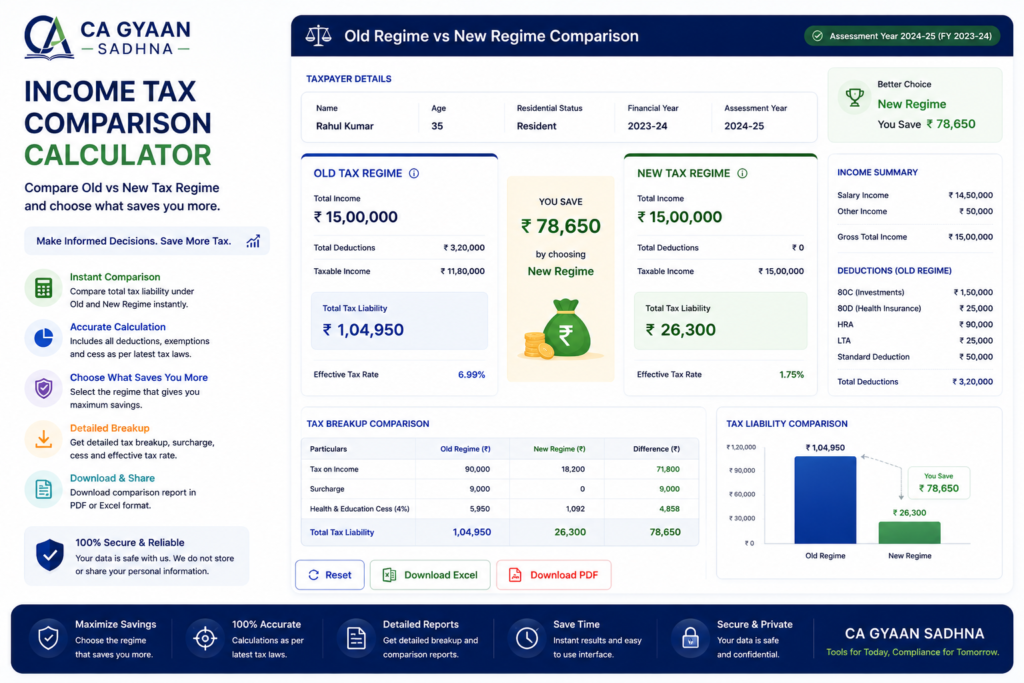
Income Tax Comparison Calculator (Old vs New Regime)
Choosing between the old and new income tax regime can significantly impact how much tax you pay each year. Our Income Tax Comparison Calculator lets you enter your income, deductions, and exemptions to instantly see your tax liability under both regimes — so you can make an informed choice before filing your return.
How This Calculator Works
Simply enter your annual income, along with deductions such as Section 80C investments, HRA, and standard deduction. The calculator computes your tax payable under both the old regime (with deductions) and the new regime (with lower slab rates but fewer deductions), then shows you the difference side by side.
Old Regime vs New Regime — Which Should You Choose?
The old regime benefits taxpayers who claim significant deductions — such as those with home loans, insurance premiums, PPF contributions, or HRA exemptions. The new regime suits those with fewer deductions, offering simpler filing and lower base rates. Since this choice can change every financial year based on your circumstances, it’s worth recalculating each time before filing.
Frequently Asked Questions (FAQs)
1. What is the Old vs New Tax Regime Comparison Calculator?
This is a free online tool that helps you compare your income tax liability under the Old Tax Regime and the New Tax Regime, so you can choose the option that saves you more money for the financial year.
2. What is the difference between the Old and New Tax Regime?
The Old Regime allows various deductions and exemptions (like 80C, HRA, home loan interest, standard deduction) but has higher tax slab rates. The New Regime offers lower slab rates but removes most deductions and exemptions, with only a few exceptions like the standard deduction.
3. What details do I need to use this calculator?
You typically need your gross annual income, applicable deductions (such as 80C investments, HRA, home loan interest, insurance premiums), and any other exemptions you claim under the Old Regime.
4. Which regime should I choose?
It depends on your income level and how many deductions/exemptions you claim. If you have significant investments, HRA, or home loan interest, the Old Regime may benefit you more. If you claim few deductions, the New Regime’s lower rates may result in less tax. This calculator shows you the exact numbers so you don’t have to guess.
5. Can I switch between the Old and New Regime every year?
Salaried individuals can choose a different regime each financial year. However, individuals with business or professional income have restrictions on switching back once they opt for a particular regime, so it’s worth checking the applicable rule for your income type.
6. Is the New Tax Regime the default option now?
Yes, as per current rules, the New Tax Regime is the default option. If you want to opt for the Old Regime, you need to specifically choose it while filing your return or inform your employer for TDS purposes.
7. Does this calculator account for the latest tax slabs?
Yes, the calculator is updated to reflect the latest applicable income tax slabs and rates for both regimes. [Confirm this is actually true and update whenever the Budget changes rates, so this claim stays accurate.]
8. Is this calculator free to use?
Yes, this Old vs New Tax Regime Comparison Calculator is completely free, with no login or signup required.
9. Can I use this calculator for business income as well as salary income?
[Answer this based on how your tool is actually built — e.g., “This calculator is designed for salaried individuals. Business/professional income has different regime-switching rules and may need separate calculation.”]
10. How accurate is this calculator?
The calculator uses the applicable income tax slab rates and standard deduction rules to give you an accurate comparison. However, for complex income situations (multiple income sources, capital gains, etc.), it’s advisable to consult a tax professional for final filing decisions.
Useful Links
Purchase Register vs GSTR-2B reconciliation tool
When considering your options, the Income Tax Comparison Calculator can serve as a valuable tool in assessing the old and new tax regimes. The old regime allows for substantial deductions that can significantly reduce taxable income, making it advantageous for individuals with various financial commitments. Conversely, the new regime streamlines the process for those with fewer deductions, providing ease of filing and appealing lower rates. Utilizing a tax regime calculator annually can help you make an informed choice that aligns with your financial situation.
Choosing between the old and new income tax regime can significantly impact how much tax you pay each year. Our Income Tax Comparison Calculator lets you enter your income, deductions, and exemptions to instantly see your tax liability under both regimes — so you can make an informed choice before filing your return.
Simply enter your annual income, along with deductions such as Section 80C investments, HRA, and standard deduction. The calculator computes your tax payable under both the old regime (with deductions) and the new regime (with lower slab rates but fewer deductions), then shows you the difference side by side.
The old regime benefits taxpayers who claim significant deductions — such as those with home loans, insurance premiums, PPF contributions, or HRA exemptions. The new regime suits those with fewer deductions, offering simpler filing and lower base rates.
Since this choice can change every financial year based on your circumstances, it’s worth recalculating each time before filing. A change in salary, a new home loan, or a shift in your investment habits can all tip the balance from one regime to the other.
Many salaried employees assume their regime choice from last year still applies, only to realize during filing season that the numbers have changed. Running this comparison early in the financial year — rather than waiting until March — gives you time to adjust your investments or deductions if the old regime turns out to be more beneficial for you.
Self-employed professionals and business owners face a similar decision, though with an added consideration: switching between regimes has different rules for those with business income compared to salaried individuals. Our calculator gives you a clear starting point either way, though we’d recommend confirming your final choice with a tax professional if your income sources are complex.
Understanding the difference between these two regimes also helps with year-round financial planning. If the old regime works better for you, it may be worth prioritizing tax-saving investments like ELSS funds, PPF, or life insurance earlier in the year rather than scrambling in the last quarter. If the new regime suits you better, you can focus your investment decisions purely on returns rather than tax-saving structures.
Already planning your loan repayment? Balance it out by checking how your savings could grow with our SIP Calculator — a smart way to plan investments alongside your loan commitments. If you’re claiming home loan deductions under the old regime, our Loan EMI Calculator can help you see your full repayment schedule.
Also planning for the long term? Use our SIP Calculator to see how your tax savings could grow if invested, or check our Loan EMI Calculator if you’re claiming home loan deductions.